Getting good visual quality out of the GSO RC 8″ can be challenging. There are quite a lot of variables that can negatively impact the imaging performance. I’ll review some of them and what I did to improve the scope’s performance.
Focuser Tilt
With a heavy image train, the standard focuser this scope is delivered with suffers from variable tilt as the scope pans around during an imaging session. This means stars will be elongated in different directions during a session – making it hard to correct in software as well as loss of detail.
One way to improve this is to switch to a focuser that supports higher weight. Such as …. This improves the variable tilt and is significantly more robust as focus change due to the camera weight pulling on the focuser.
Mirror Cell Tilt
Unfortunately, the focuser is not the only source of tilt. The focuser is attached directly to the mirror cell and will cause a variable tilt in the same way. Fixing this is a different ordeal, and not possible with off-the-shelf parts. Through forums, I found someone that would machine a custom backplate that attaches directly to the tube backend rather than the mirror cell – meaning that practically, regardless of weight, it cannot tilt the mirror cell.
Collimation
One way of collimating both mirrors is using an OCAL electronic collimator, however this method can be difficult to use for the secondary mirror. So in addition to describing the process of collimating using OCAL I will also present additional / supplemental methods.
Collimation of Primary Mirror
In addition to using OCAL a similar process can be used visually using a cheshire eyepiece and pointing the scope at a target. (PDF)
https://britastro.org/2018/kitchen-table-collimation-of-a-cassegrain-type-reflector
Collimation of Secondary Mirror
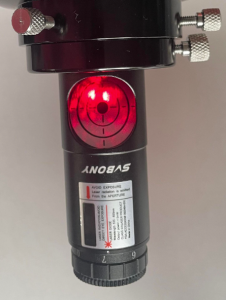
The easiest way to collimate the secondary mirror is by using a laser collimator. The laser collimator is attached to the focuser and will shine a laser into the secondary mirror thats reflected back at the collimator with the goal of getting the return beam hit the laser source. If the secondary mirror is off-axis the laser will hit off-center as shown in the picture. Collimate by adjusting the screws on the secondary mirror until the laser hits the center.